Astrocartography: Where Should I Live?

Astrocartography is a fascinating tool for astrology enthusiasts and those seeking to improve their lives by understanding the energies of different locations around the world. Have you been wondering, “Where should I live?” Astrocartography can help you identify the places where the planetary energies are most supportive of your life goals and aspirations.
What exactly is astrocartography? Essentially, it’s the mapping out of your astrological birth chart, showing exactly where each planet was passing over Earth at the moment of your birth. With astrocartography, instead of choosing a place and hoping for the best, you're making an informed and conscious decision about where to put yourself next.
In this blog post, we will explore the basics of astrocartography and provide some tips for using it to identify the best place to live.
Start With What You Actually Want
Before you look at a single line on your map, get clear on what you're actually trying to create in the next three to five years. Not the vague version. The specific one.
Not "I want to be happy" but "I want to find a serious relationship." Not "I want things to be better" but "I want my career to finally get the recognition it deserves." Not "I need a change" but "I need to heal and I need somewhere that supports that."
The more specifically you can name what you're looking for, the more useful your map becomes. Your intention is the filter through which you read everything else. Without it you're just looking at colored lines on a world map with no way to prioritize what matters.
Write it down before you open your map. One or two sentences. What do I most want my life to look like, and what do I need a new location to support?
Generate Your Map
If you haven't generated your astrocartography map yet, head to Astro.com. It's free, takes less than five minutes, and is the platform used by professional astrologers worldwide. Enter your birth date, time, and place, click on Horoscopes, then Locational Astrology, then AstroClick Travel. Your personal world map will appear with all 44 of your planetary lines visible.
Your birth time matters more here than almost anywhere else in astrology. Even a few minutes' difference can shift a planetary line by hundreds of miles. If you're not certain of your exact birth time, your long-form birth certificate or hospital records are the best places to find it. An approximate time still gives you a useful map, but treat the angular lines with less certainty until you can verify the time.
How to Read an Astrocartography Map walks through the full process of generating and understanding your chart if you're starting from scratch.
Understand What the Lines Mean for Your Goals
Once you have your map, the next step is matching your intention to the planetary lines most relevant to it. Different lines support different areas of life, and knowing which ones to prioritize for your specific goals saves you from getting distracted by lines that simply aren't relevant to what you're looking for right now.
If You're Looking for Love
Focus first on your Venus lines, particularly the Venus Descendant. The Descendant angle governs who and what you attract into your closest relationships, and Venus on that angle is the single most direct signal on your entire map that love is genuinely available in a particular location. People who relocate to their Venus Descendant line consistently report a shift in the quality of the people they meet, warmer, more genuine, more emotionally available than they experienced where they were living before.
Your Moon lines are also worth prioritizing for love, particularly the Moon Descendant. The Moon draws out emotional intimacy and creates conditions where genuine connection comes more naturally. If you've felt like meaningful relationships are hard to come by where you currently live, check where your Venus and Moon lines fall. There's a good chance they run somewhere very different.
If You're Looking for Career Growth
Focus on your Mercury, Jupiter and Sun astrocartography lines, particularly where they fall on the Midheaven. The Midheaven angle governs your career, public image, and professional reputation. A Jupiter Midheaven line is arguably the most powerful career location on your entire map. Doors open with less friction here. People in positions of influence find you credible and worth investing in. Opportunities arrive that would have taken years to create elsewhere.
A Sun Midheaven line puts you in the spotlight professionally. Your work gets noticed. Leadership roles feel more natural and are more readily offered. A Mercury Midheaven line makes you known for what you say and how you say it, which is particularly valuable for anyone in communications, media, education, or any field where how you articulate your ideas determines how far you go.
If You're Looking for Health and Vitality
Focus on your Jupiter and Sun astrocartography lines. People near their Jupiter line tend to enjoy robust general health and a resilience that means issues, when they do arise, resolve more quickly than they would elsewhere. People near their Sun line report feeling more energized, more physically purposeful, and more capable of sustaining the demands of daily life.
Just as important as finding supportive lines is identifying which lines may be working against your health. If you've been dealing with persistent physical issues that haven't responded well to treatment, check whether your Saturn or Pluto line runs through where you currently live. Many people find that chronic conditions they struggled with for years begin to resolve with surprising speed once they move away from a challenging line.
If You're Looking for a Sense of Home and Belonging
Focus on your Moon lines, particularly the Moon IC. The IC, or Imum Coeli, is the most private and inward of the four angles, representing home, roots, and the deepest layers of who you are. People living on a moon line astrocartography describe it consistently as the first place they've ever been able to truly exhale. If you've spent your life feeling like a bit of an outsider wherever you've lived, your Moon IC line is the most important line to find on your map.
If You're Looking for Spiritual Growth or Healing
Consider your Neptune, Chiron, and North Node lines. Neptune opens channels of inspiration and spiritual depth. Chiron creates the conditions for deep and lasting transformation, working through the wounds you've carried longest and turning them into genuine wisdom. Your North Node line connects you to your soul's purpose and the relationships that carry the most meaning.
These lines aren't always comfortable. But for someone in a genuine season of growth and healing, they can be the most meaningful locations on the entire map. The Chiron Line in Astrocartography: Healing, Wounds, and Deep Transformation goes into what that experience actually looks like in practice.
The Lines to Approach Carefully
Knowing where to look is only half the picture. Knowing what to watch out for is just as important.
Saturn is one of the most challenging lines on the map. Near it everything feels harder than it needs to. Career recognition comes slowly. Relationships carry a heaviness. There's a persistent loneliness that follows you even into crowded rooms. If you've been living somewhere for years and can't figure out why things never quite fall into place despite everything you're doing right, check whether your Saturn line runs through that area.
One of Saturn's most significant qualities is how difficult it makes leaving once you're there. There's always one more reason to stay just a little longer. If you're living near your Saturn line and recognize that pattern, start planning your exit even before you know where you're going. Astrocartography Best Lines and Worst covers all the challenging lines in detail.
Pluto brings intensity, upheaval, and a high emotional cost to daily life. Transformation is available here but it rarely arrives gently. If a city you're drawn to has a Pluto line running through it, ask yourself honestly whether you're drawn to the city itself or to the intensity Pluto creates.
A Simple Framework for Making the Decision
Here's a practical process for using your map to answer the question of where you should live.
Step one: Write down what you most want your life to look like in the next three to five years. Be specific.
Step two: Identify which planetary lines are most relevant to those goals using the guide above.
Step three: Pull up your map and note every location where those favorable lines fall within 700 miles of somewhere you could realistically live.
Step four: For each location you're considering, note every planetary line within 700 miles and identify the combination. Look for favorable combinations and be honest about challenging ones.
Step five: Check the angles. For each line within range, note whether it falls on the AC, DC, MC, or IC. That tells you which area of your life it'll affect most directly.
Step six: Cross-reference with your practical realities. Which of the locations that look good on your map are also viable given your job, finances, family, and personal circumstances?
Step seven: Make a conscious decision. Not a perfect one. There's no perfect location anywhere on any map. But an informed one, made with the full picture rather than just the surface.
Ready to Go Deeper?
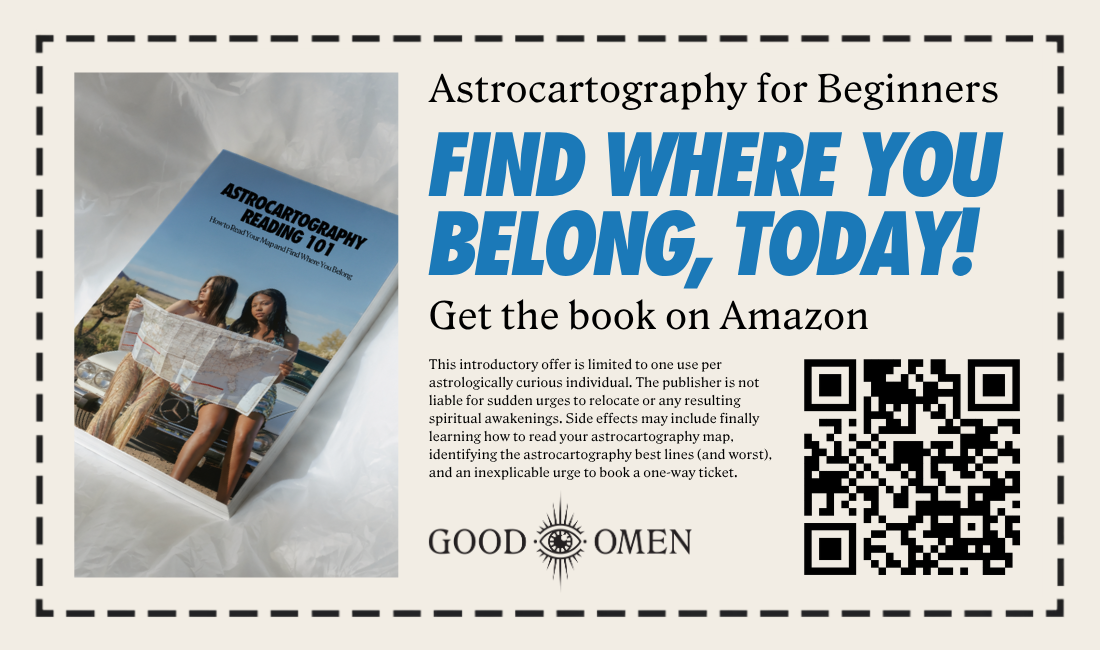
If you want a complete guide to every planetary line, all four angles, how to evaluate line combinations, and a clear practical framework for finding the locations where your life can truly flourish, Astrocartography for Beginners gives you everything you need.
Every planetary line's explained in plain language. The framework's clear and practical. And by the last page you'll know exactly which locations in the world give you the best chance at the love, career, and life you've been working toward.