How to Read an Astrocartography Map

Astrocartography is a unique and powerful tool that combines astrology and cartography to map out the energy and influences of different locations on your life's journey. By analyzing your birth chart and aligning it with the planetary energies present in different parts of the world, astrocartography helps you understand the challenges and opportunities you may face in different locations, as well as the best places for you to thrive and grow.
Here's how to read your astrocartography map, step by step:
Step One: Locate Your Birthplace, Date, and Time
Your birthplace, date, and time is the starting point for reading your astrocartography map. Most people know when and where they were born, but to read an astrocartography map you also need to know the exact time. It should be on your birth certificate, but if it's not, consider contacting the hospital where you were born. Hospital records often include the exact time of delivery and are worth the effort of requesting.
Why does birth time matter so much? Because even a difference of a few minutes can shift a planetary line by hundreds of miles. The most powerful lines on your map, the ones tied to the Ascendant, Descendant, Midheaven, and Imum Coeli, are calculated directly from your birth time. Without it your map is still useful, but it's incomplete in ways that matter when you're using it to make real decisions.
If you genuinely can't find your birth time, some practitioners work with a noon chart as a placeholder. Just know that the angular lines won't be precise and the map should be treated as a general picture rather than an exact one.
Step Two: Generate Your Map
The most widely used and trusted platform for generating your astrocartography chart is Astro.com. It's free, reliable, and used by professional astrologers around the world. You don't need any special software or prior knowledge of astrology to get started.
Step Three: Understand What You're Looking At
After generating your map you'll see a world map covered in 44 multicolored lines crossing over it. These are called planetary lines, and each one is associated with a specific planet, energy, and color. For example, the Sun line is orange. So wherever you see orange lines on your map, you know that's your Sun energy. Each planet has its own color, making it easier to visually identify which energies are active in which parts of the world.
These 44 lines represent the positions of the Sun, Moon, Mercury, Venus, Mars, Jupiter, Saturn, Uranus, Neptune, Pluto, Chiron, and the Moon's Nodes, each appearing in four different forms based on where the planet was positioned at the moment of your birth. More on those four forms in a moment.
You'll likely notice that some parts of the world have several lines clustered together while others are relatively quiet. Both are meaningful. Clustered lines mean multiple planetary energies are active in that region simultaneously, which creates a more complex and layered experience. Quiet regions with no lines nearby carry a neutral, low-charge energy that some people find restful and others find flat.
Step Four: Understand That Each Planet Has Its Own Frequency
Each planet holds its own energetic frequency. When you're looking at your map, you're looking at how the different energies of different planets are influencing different places around the globe.
For example, let's say your Moon line goes through Sedona, Arizona. The Moon is known to draw out emotions, intuition, and empathy. So if you traveled to Sedona, you'd access the nurturing, empathetic, and intuitive energy of that Moon line. You'd likely feel more emotionally open, more connected to your inner world, and more tuned in to the people around you than you might elsewhere.
As each planet represents its own unique energy, where the planets fall on your map establishes your unique chemistry with those locations. When you live on or travel to parts of the world near your planetary lines, you access their energies and bring either desirable or undesirable circumstances into your life.
Here's a quick reference for what each planet brings:
Sun: Identity, vitality, recognition, leadership, creative self-expression. One of the most favorable lines on the map.
Moon: Emotion, intuition, belonging, home, and family. The astrocartography moon line is deeply nurturing for the right person, potentially depleting for someone without strong boundaries.
Mercury: Communication, mental clarity, social connection, learning. The mercury line astrocartography is one of the most consistently favorable lines across different personality types.
Venus: Love, beauty, attraction, relationships, creativity. The venus line astrocartography is one of the most sought-after lines on the map.
Mars: Drive, ambition, physical energy, competition, conflict. The mars line is invigorating for some, exhausting for others.
Jupiter: Abundance, opportunity, good fortune, expansion. Known as the fame line. One of the most broadly beneficial lines on the map.
Saturn: Discipline, restriction, hard lessons, slow-earned success. One of the most challenging lines on the map.
Uranus: Freedom, revolution, unpredictability, innovation. Exciting for those who thrive on change, destabilizing for those who don't.
Neptune: Spirituality, dreams, creativity, dissolution. Beautiful for artists and healers, disorienting for people who need practical structure.
Pluto: Transformation, power, intensity, death and rebirth. One of the most challenging lines on the map.
Chiron: Healing, wounds, transformation. The wounded healer line. Deeply meaningful for the right person at the right time.
North Node: Soul purpose, destiny, meaningful relationships and community.
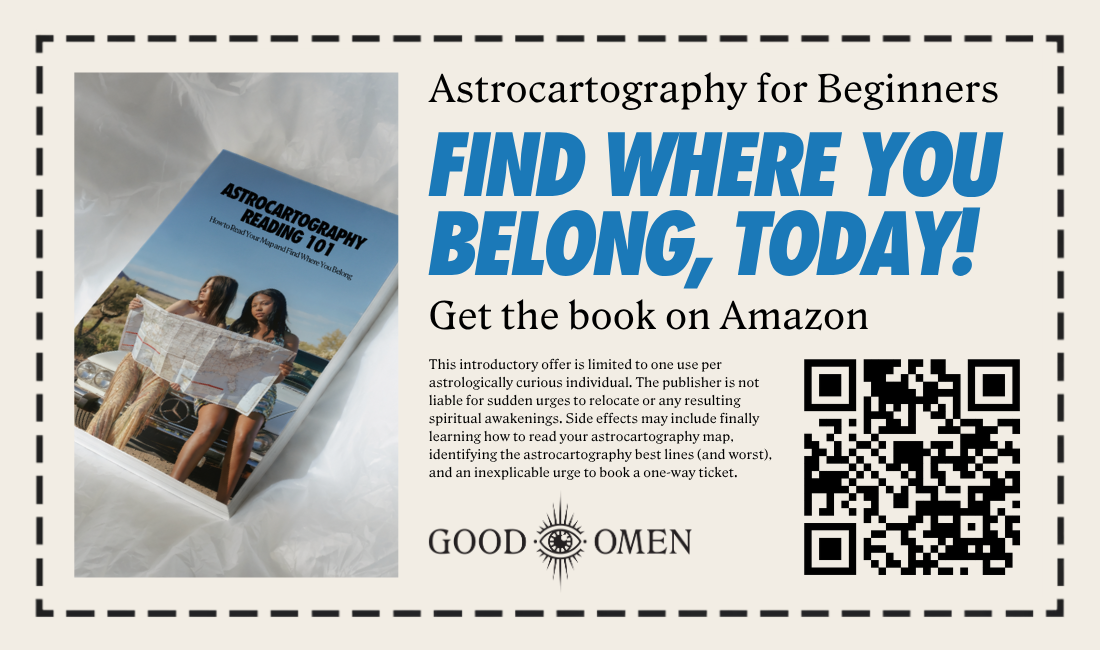
For a complete breakdown of the pros and cons of each planetary line, grab a copy of Astrocartography for Beginners.
Step Five: Consider How the Energy Affects You Specifically
The energy of the planetary lines affect how you personally experience life, but also the way other people view or accept you. For example, Mars is a blunt, direct, masculine energy, and even if you’re someone that’s more of a lover than a fighter, when living on your Mars line, you might find that people are projecting this aggressive energy onto you. You’ll be seen as more direct and aggressive, which could be good if you’re a man or potentially bad if you’re a woman. These are things you need to take into account when reviewing your map. Think of the planets like filters through which you see the world, and also through which the world sees you.
Step Six: Interpret the Best Places to Live and Travel
Astrocartography isn’t super cut and dry. There is a bit of an art and a science to it. As you’ll see on your own map, more often than not, there isn’t going to be a location with just one Planetary Line near it. Typically, there are many Planetary Lines that will have an energetic influence on the location you're considering. So even though the Sun line is amazing, you may have Mars next to it, muddling it up with its aggressive energy. For some, especially masculine men, living near their Mars line might be totally manageable, for others it could be really intense. You have to know yourself and what you’re willing to deal with. In this section of the course, I’m going to show you have to evaluate the options for yourself. Want to go deeper?
How Astrocartography Can Improve Your Life
Once you know how to read your map, here's how to use it practically.
Finding the Best Place to Live - Astrocartography can help you find the best place to live based on your astrological chart. By analyzing your birth chart, you can determine which areas of the world have planetary energies that are most beneficial for you.
Enhancing Career and Business Opportunities - Astrocartography can also help you enhance your career and business opportunities. By identifying the areas of the world where the planets are most supportive of your career goals, you can focus your efforts in those locations.
Improving Relationships - You can identify the areas of the world where you are most likely to find compatible partners or form stronger connections with the people around you. For example, Venus is associated with love and relationships, you may consider moving to a location where Venus is prominent. This could increase your chances of finding a compatible partner or forming stronger connections with the people around you.
Improving Health - By identifying the areas of the world where the planets are most supportive of your health, you can focus your efforts on maintaining a healthy lifestyle in those locations. The Sun is associated with vitality and energy. Moving to your Sun line could help you maintain a healthy lifestyle and improve your overall wellbeing.
Enhancing Personal Growth - Astrocartography can also help enhance your personal growth. By identifying the areas of the world where the planets are most supportive of your personal development, you can focus your efforts on self-improvement in those locations. Your Mercury line could provide you with opportunities to improve your communication skills and engage in intellectual pursuits that can help you grow personally.
Ready to Go Deeper?
This post covers the foundations of how to read your astrocartography map. But understanding every planetary line in full detail, including the shadow side of each, how line intersections work, how to evaluate cities for multiple people, and how to use your map to make real decisions about where to live, travel, and build your life, is exactly what Astrocartography for Beginners was written for.
Every planetary line's explained in plain language. The framework's clear and practical. And by the last page you'll know exactly which locations in the world give you the best chance at the love, career, and life you've been working toward.